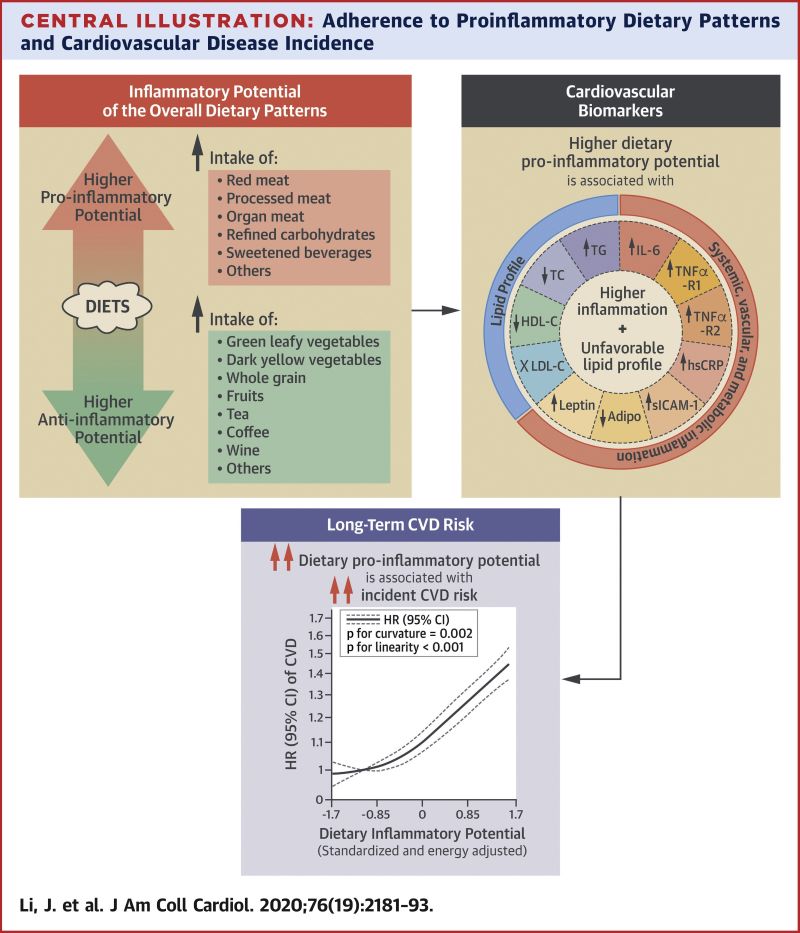
Dietary patterns with a higher proinflammatory potential were associated with higher CVD risk. Reducing the inflammatory potential of the diet may potentially provide an effective strategy for CVD prevention.
Background
Inflammation plays an important role in cardiovascular disease (CVD) development. Diet modulates inflammation; however, it remains unknown whether dietary patterns with higher inflammatory potential are associated with long-term CVD risk.
I described another option to Grandpa: he could voluntarily stop eating and drinking. He’d never considered this possibility (which reminded me again how one’s family members and clinicians contribute to inequities in end-of-life care). The option intrigued Grandpa, and during subsequent visits he reinforced his plan to pursue it. I insisted that he first move into my home. I wanted to ensure the quality of his care, knowing that I could enroll him in my health system’s hospice program. But I also wished to test his resolve, reasoning that his mind might change once his isolation ended.
For a month after he entered our home, his spirits were brighter, his gait steadier, and his appetite heartier. He joined my wife, two daughters, and me for dinner each night, typically preceded by a vodka martini that I had stirred for him — a daily pleasure he’d allowed himself for 80 years and had missed as a facility resident. He’d tell stories of the Navy, his career, and his family history and would regularly quip, “If you keep treating me this well, I might just stick around a while longer!”
But eventually he returned to his goal of hastening death. One night, he said he was ready to stop eating and drinking the next morning, but when morning came, he asked for his usual coffee and bagel. He confided that he was scared. When I asked of what, he replied, “It’s like trying to roller skate. I’m scared of starting. Though I know that once I do, I’ll probably roll.”
Internet-connected “smart” devices are increasingly available in the marketplace, promising consumers and businesses improved convenience and efficiency. Within this broader Internet of Things (IoT) lies a growing industry of devices that monitor the human body and transmit the data collected via the internet.
This development, which some have called the Internet of Bodies (IoB), includes an expanding array of devices that combine software, hardware, and communication capabilities to track personal health data, provide vital medical treatment, or enhance bodily comfort, function, health, or well-being. However, these devices also complicate a field already fraught with legal, regulatory, and ethical risks. In this video,
RAND mathematician Mary Lee examines this emerging collection of human body–centric and internet-connected technologies; explores their benefits, security and privacy risks, and ethical implications; surveys the nascent regulatory landscape for these devices and the data they collect; and makes recommendations to balance IoB risks and rewards.
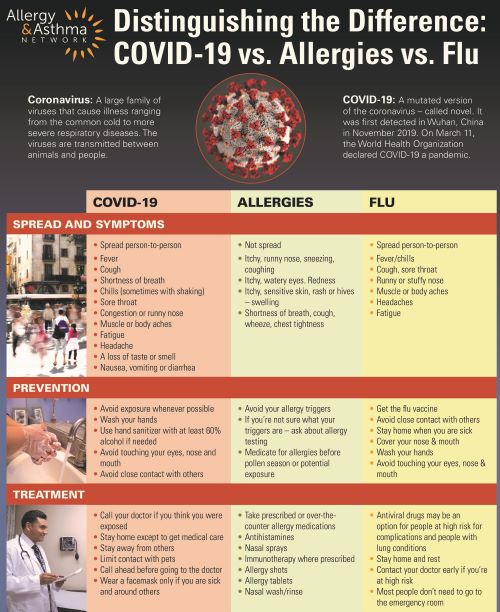
Anthony S. Fauci, MD returns to JAMA’s Q&A series to discuss the latest developments in the COVID-19 pandemic, including the continued importance of nonpharmaceutical interventions (masking, handwashing, physical distancing) for managing rising case numbers in the US and globally.
Recorded October 28, 2020.
Topics discussed in this interview: 0:00 Introduction 0:20 NAM Presidential Citation for Exemplary Leadership 1:19 COVID-19 numbers and excess deaths 4:05 National masking mandate 5:55 How to get people to accept masking 7:07 Herd Immunity and the Great Barrington Declaration 9:51 The holidays and airplane travel 13:44 Therapies update 17:54 Vaccines update 20:08 Vaccine distribution 22:00 Vaccine safety 24:42 How Australia has dealt with COVID-19 spikes 27:00 Acknowledgements and baseball
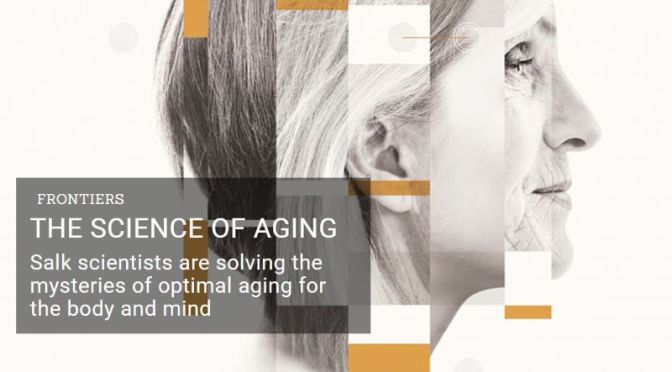
“Aging is such a profound part of not only the human experience but all life on Earth,” says Salk Vice President/Chief Science Officer Martin Hetzer. “It’s one of the big, untapped opportunities in biomedical research, particularly around questions on what role exercise, nutrition and cognitive stimulation play in staying healthy throughout life. It is important not to forget that getting older also comes with benefits; we want to take a holistic view of human health at all ages and understand it from all angles.”
Scientists want to answer intriguing questions: Why are some people able to “age well,” trekking up mountain ranges or rafting through white water in their nineties, while others live just as long, disease-free, but grow inexplicably frail decades sooner? Worse yet, why does advanced age sometimes diminish cognitive ability or even lead to dementia?
In numerous diseases, age itself is the major risk factor. Cancer, Alzheimer’s, heart disease and many other afflictions become profoundly more likely the older we get. Aside from extending our life spans, scientists want to know how we can also extend our health during advanced age. What is emerging from research is that aging–loosely defined as a systems-wide deterioration of our cells, organs and genetic material that results in disease or damage–is a collective and complex process in the body.
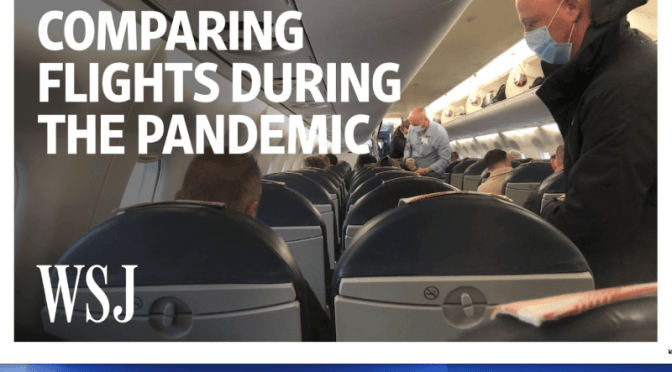
As airports and airlines around the world continue to operate in the midst of a global pandemic, not every flight and region has the same Covid-19 protocols. Three WSJ reporters flew to different regions around the world to look at how air travel has changed.
In this cross-sectional study of 5364 couples consisting of employees and spouses (or domestic partners) undergoing an annual employer-sponsored health assessment, 79% of the couples were in the nonideal category of a CV health score. This within-couple concordance of nonideal CV health scores was associated mostly with unhealthy diet and inadequate physical activity.
The study included 10 728 participants (5364 couples): 7% were African American, 11% Hispanic, 21% Asian, and 54% White (median [interquartile range] age, 50 [41-57] years for men and 47 [39-55] for women). For most couples, both members were in the ideal category or both were in a nonideal category.
Concordance ranged from 53% (95% CI, 52%-54%) for cholesterol to 95% (95% CI, 94%-95%) for diet. For the CV health score, in 79% (95% CI, 78%-80%) of couples both members were in a nonideal category, which was associated mainly with unhealthy diet (94% [95% CI, 93%-94%] of couples) and inadequate exercise (53% [95% CI, 52%-55%] of couples). However, in most couples, both members were in the ideal category for smoking status (60% [95% CI, 59%-61%] of couples) and glucose (56% [95% CI, 55%-58%]).
Except for total cholesterol, when 1 member of a couple was in the ideal category, the other member was likely also to be in the ideal category: the adjusted odds ratios for also being in the ideal category ranged from 1.3 (95% CI, 1.1-1.5; P ≤ .001) for blood pressure to 10.6 (95% CI, 7.4-15.3; P ≤ .001) for diet. Concordance differed by ethnicity, socioeconomic status, and geographic location.








 Intellicurious