Tag Archives: Science

Podcast Interviews: “Exercise Is Medicine” Author Judy Foreman

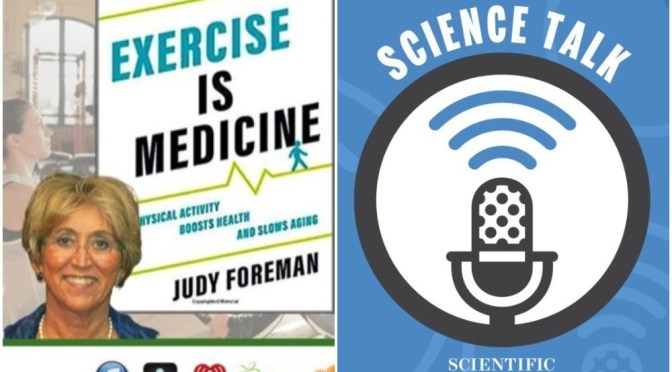
Science Talk logoHealth journalist Judy Foreman talks about her new book Exercise Is Medicine: How Physical Activity Boosts Health and Slows Aging
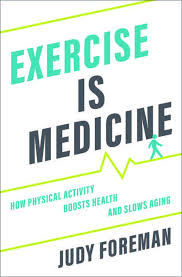
downloadThis is Scientific American’s Science Talk, posted on April 24th, 2020. I’m Steve Mirsky. And under our current, often locked-down situation, it’s still really important to try to get some exercise. Judy Foreman is the author of the new book Exercise is Medicine: How Physical Activity Boosts Health and Slows Aging. She’s a former nationally syndicated health columnist for the Boston Globe, LA times, Baltimore Sun and other places, and an author for the Oxford University Press.

Judy Foreman is the author of “A Nation in Pain” (2014), “The Global Pain Crisis” (2017), and “Exercise is Medicine,” (2020), all published by Oxford University Press, and was a staff writer at The Boston Globe for 22 years and the health columnist for many of these years. Her column was syndicated in national and international outlets including the Los Angeles TimesDallas Morning NewsBaltimore Sun and others.

She graduated Phi Beta Kappa from Wellesley College and has a Master’s from the Harvard Graduate School of Education. She was a Lecturer on Medicine at Harvard Medical School, a Fellow in Medical Ethics at Harvard Medical School and a Knight Science Journalism Fellow at the Massachusetts Institute of Technology. She spent six months as a guest reporter for The Times of London. She was also a Senior Fellow at the Schuster Institute for Investigative Journalism at Brandeis University. She was also host of a live, weekly call-in radio show on Healthtalk.com.

Judy has won more than 50 journalism awards, including a 1998 George Foster Peabody award for co-writing a video documentary about a young woman dying of breast cancer and the 2015 Science in Society award from the National Association of Science Writers.
Website

New Science Podcasts: How Coronavirus Kills People, Quantum Diamond Microscopes & Magnetism

science-magazine-podcastsCoronavirus affects far more than just the lungs, and doctors and researchers in the midst of the pandemic are trying to catalog—and understand—the virus’ impact on our bodies. Staff Writer Meredith Wadman joins host Sarah Crespi to discuss what we know about how COVID-19 kills. See all of our News coverage of the pandemic here, and all of our Research and Editorials here.
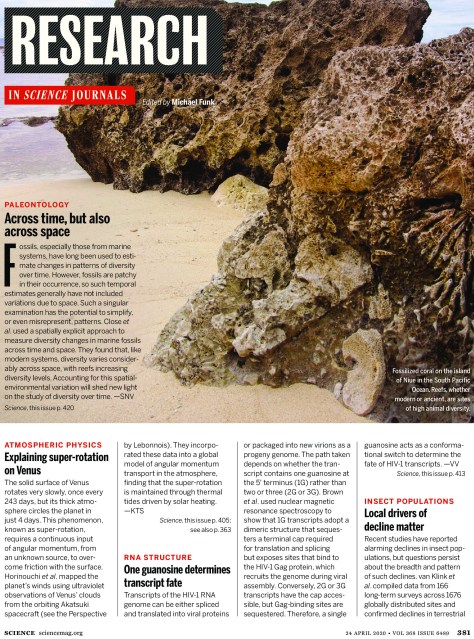
Also this week, Staff Writer Paul Voosen talks with Sarah about quantum diamond microscopes. These new devices are able to detect minute traces of magnetism, giving insight into the earliest movements of Earth’s tectonic plates and even ancient paleomagnetic events in space.

Top Science Podcasts: Our Ancient Hominin Species DNA, Vikings, Lemur Love & “Gargantuan” Hail Stones

nature-podcasts23 April 2020: Denisovan DNA in modern Europeans, and the birth of an unusual celestial object. This week, evidence of ancient hominin DNA in modern human genomes, and the origin of a snowman-shaped object at the edge of the solar system.
In this episode:

00:45 Intermixing of ancient hominins

By combing through the DNA of over 27,000 modern day Icelanders, researchers have uncovered new insights about the ancient hominin species who interbred with Homo sapiensResearch Article: Skov et al.

08:05 Research Highlights

The scent of lemur love, a hidden Viking trade route, and ‘gargantuan’ hail. Research Highlight: Lemurs’ love language is fragranceResearch Highlight: Vikings’ lost possessions mark a long-hidden early trade routeResearch Highlight: Enormous hailstones inspire a new scientific size category: ‘gargantuan’

11:44 The origin of Arrokoth

In 2019, the New Horizon Spacecraft took images of Arrokoth – an unusual, bi-lobal object found in the Kuiper belt. Now, researchers believe they’ve figured out how it formed. Research Article: Grishin et al.

17:29 Pick of the Briefing

We pick some highlights from the Nature Briefing. This week we discuss why the Universe may be lopsided, and why water could actually be two different liquid states. Scientific American: Do We Live in a Lopsided Universe?Chemistry World: The weirdness of water

Covid-19 Podcast: Testing Lab Challenges, WHO Funding & Immune System Issues (Nature.com)

nature-podcastsBenjamin Thompson, Noah Baker, and Amy Maxmen discuss Trump withholding funds from the WHO, and how COVID-19 kills. We also hear about controlling misinformation while communicating risk.

In this episode:

01:15 Understanding bottlenecks

After listening to last week’s episode of Coronapod, researchers in the USA were inspired to start collecting data about the challenges facing labs carrying out testing. After more than 4,000 responses to their online survey, we discuss their goals.

03:08 A hole in the WHO’s funding

US President Donald Trump has announced plans to withhold funding for the WHO, pending a review of the organization’s handling of the pandemic. We discuss the decision and ask what it means for the global response to COVID-19.

News: Nature‘s rolling coronavirus news blog

05:55 Responding to the immune system

We investigate the role of the immune system in the death of COVID-19 patients and what this could mean for treatments. Could some therapeutics actually be undermining the body’s ability to fight the virus?

News: How does COVID-19 kill? Uncertainty is hampering doctors’ ability to choose treatments

13:54 One good thing this week

Our hosts pick out things that have made them smile in the last 7 days, including seasonal memories from Sierra Leone, a trip to the supermarket, and the 99-year old war veteran who has raised millions for charity.

BBC News: Coronavirus: Capt Tom Moore’s NHS fundraiser hits £17m

18:33 Communicating complex data

Clearly communicating risks and evidence is key for governments and other organisations if they are to best inform the public during the pandemic. But what is the best way to do it? We hear the methods that communications experts and behavioural scientists recommend to keep the public informed, and keep misinformation at bay.

Top New Science Podcasts: Countries’ Coronavirus Comebacks, Managing Water & The Ancient Wari

science-magazine-podcastsContributing Correspondent Kai Kupferschmidt talks with host Sarah Crespi about countries planning a comeback from a coronavirus crisis. What can they do once cases have slowed down to go back to some sort of normal without a second wave of infection?

Contributing Correspondent Lizzie Wade joins Sarah to talk about water management and the downfall of the ancient Wari state. Sometimes called the first South American empire, the Wari culture successfully expanded throughout the Peruvian Andes 1400 years ago.

Also this week, Yon Visell of the University of California, Santa Barbara, talks with Sarah about his Science Advances paper on the biomechanics of human hands. Our skin’s ability to propagate waves along the surface of the hand may help us sense the world around us.

Neuroscience: “What Is It Like To Have Synesthesia?” (The Royal Institution)

Can you imagine if each word had its own colour, or you could ‘see’ different types of music?

Synesthetes can experience the ordinary world in some pretty extraordinary ways. In this video Jamie Ward explains the variety of different ways in synesthesia can manifest itself, and what is happening in the brains of those who experience it.

Jamie Ward is Professor of Cognitive Neuroscience at the University of Sussex. He has written books a number of books about neuroscience and synesthesia.

Website

Synesthesia is a perceptual phenomenon in which stimulation of one sensory or cognitive pathway leads to involuntary experiences in a second sensory or cognitive pathway. People who report a lifelong history of such experiences are known as synesthetes. Awareness of synesthetic perceptions varies from person to person.[7] In one common form of synesthesia, known as grapheme–color synesthesia or color–graphemic synesthesia, letters or numbers are perceived as inherently colored. In spatial-sequence, or number form synesthesia, numbers, months of the year, or days of the week elicit precise locations in space (for example, 1980 may be “farther away” than 1990), or may appear as a three-dimensional map (clockwise or counterclockwise). Synesthetic associations can occur in any combination and any number of senses or cognitive pathways.

From Wikipedia

Top New Science Podcasts: Coronavirus Spreading In The Air, Eating Disorders

science-magazine-podcastsOn this week’s show, Staff Writer Robert Service talks with host Sarah Crespi about a new National Academy of Sciences report that suggests the novel coronavirus can go airborne, the evidence for this idea, and what this means for the mask-wearing debate. 

Also this week, Staff Writer Jennifer Couzin-Frankel joins Sarah to talk about a burgeoning understanding of the biological roots of anorexia nervosa—an eating disorder that affects about 1% of people in the United States. From genetic links to brain scans, scientists are finding a lot more biology behind what was once thought of as a culturally driven disorder.